By Yanto Soegiarto*
Editor’s Note:
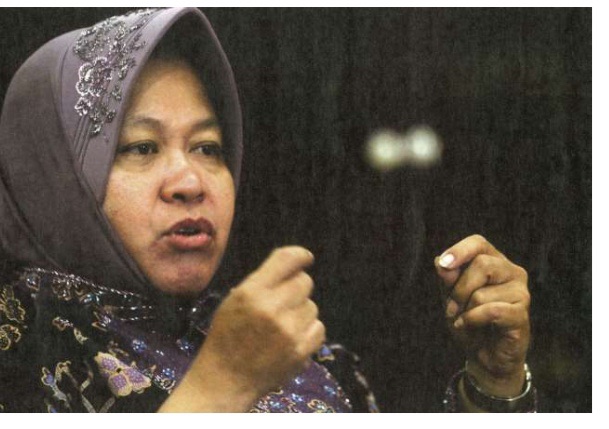
This article was written in January 2014 at the peak of Tri Rismahrini’s career as Mayor of Surabaya. The interview took place following an award presentation for her achievements in public service. Photo is exclusive to GlobeAsia magazine.
++
Tri Rismaharini fits in perfectly as mayor of Surabaya, where people in Indonesia’s second city are known to be outspoken and direct, but who have a strong sense of solidarity with their fellows. Indonesia’s prominent lady mayor, Tri Rismaharini, or Risma to the people of Surabaya, is exactly what they wanted as a mayor.
She rules with an iron fist but can be gentle, especially when dealing with temperamental residents. She implements policies using a welfare-based approach and envisages a city that is friendly, green and most of all a bustling metropolis. She insists on doing things right and won’t tolerate her citizens doing wrong when it comes to keeping the city clean and orderly.
And while there are tough regulations, they aim to make Surabaya a friendly city. Formerly known as a hot, dry placе, Surabaya now breathes fresh air with an abundance of green parks. Sidewalks are wider with benches for pedestrians to sit and enjoy the passing parade.
Indeed, Risma, known to the locals as Bu Wali (mother mayor), is transforming Surabaya into a homely, caring city. “For the first time I am proud to declare Surabaya my hometown,” longtime Surabaya resident Bambang Purwadi told GlobeAsia.
I used to hate Surabaya for its floods and congested traffic. It used to be very messy. Now I have fallen in love with the city again. Surabayans owe it to Bu Wali.”
Risma, an architecture graduate from the Surabaya Institute of Technology (ITS) and former head of the city administration’s parks department, was the first woman to ever break the decades-long dominance of male city rulers.
Uniquely, she pairs with her former boss, her predecessor as mayor, Bambang Dwi Hartono, as her deputy. She was elected mayor on 28 September, 2010 with the backing of Bambang’s party, the Indonesian Democratic Party for Struggle (PDI-P).
Risma’s principle is to work hard and try to do as much as possible for the welfare of the people of Surabaya. “We must change the mindset of all the people and the government to work hard. We must empower them. I have always taught Surabaya residents that nothing is easy. Without hard work, we can’t achieve what we want for better welfare,” Risma said.
Risma has received much praise for her achievements. Her “go green” program has won prestigious local and international awards. She has built trust in her as the city’s leader. “It’s important for the people not to be disappointed by the city administration. A leader must know what the people want and the problems they have. There are many corners ofthe city that need to be transformed into parks so that less-privileged people can enjoy the social and recreational space” she said.
Her parks do not have high fences around them, since she believes that would discourage people from using the parks.
Reversed roles
Risma maintains a harmonious partnership with her deputy, her former boss. Both adopt what they call a proportional as well as professional stance. They synergize very well and the two have earned a reputation as mentors in making Surabaya a model of a successful city. Officials from other countries learn from them and do comparison studies.
From the 1980s onward, Surabaya earned many prestigious awards including the national Adipura Kencana, Adiwiyata Mandiri and Kalpataru prizes. It was Risma who played a leading role during her early days as head of parks.
Risma, born in Kediri, East Java on November 20, 1961, dreamed that one day Surabaya would become a clean and healthy city. “Not just that, economic conditions must also be good. Welfare must be promoted but the people’s solidarity and their attitude must also be healthy,” she said.
Asked how she feels as the recipient of the people’s mandate, Risma replied that God gave her the position. “It’s an obligation, the destiny to serve the people.” Despite her busy schedule, Risma makes sure she has time for husband Djoko Saptoadji and their two children, Fuad Nenardi and Tantri Gunarni.
Recently, Risma was featured in an article Surabaya’s Mrs. Mayor: Indonesia’s Best-Kept Secret, written by Stanley Weiss and published by The Huffington Post. Weiss wrote that at Risma’s direction, brothels have been converted into kindergartens and old gas station lots have become playgrounds.
During her tenure, Surabaya was named the city with the best public participation in Asia Pacific. One of her main goals is to develop not just the city’s infrastructure and economy, but also its people. Education and civic awareness program are critical elements of her administration. She spends 35% of Surabaya’s budget on education, far above the national standard.
“I don’t really understand practical politics,” Risma confesses, somewhat surprisingly given her achievements. And it’s true that she was almost removed in her first year as mayor when she angered entrenched interests with a proposal to raise tariffs on large billboards while lowering them for small business advertisements.
When she was head of building development, Risma and her family received death threats for implementing the country’s first completely transparent, e-procurement system. Yet applying transparent governance, in her words “saved anywhere from 20%-25%” of the project cost, freeing up resources to build “better quality roads, new bridges and pedestrian areas.”
Building the city Risma has forged important partnerships with the private sector, and is savvy navigating the country’s bureaucracy. On just her second day as mayor, she arrived at the office of Indonesia’s vice president, Boediono, to discuss a critical port development project that had languished for decades.
Despite repeated efforts to brush her off, Risma refused to leave the office until it was agreed that construction should start. The port groundbreaking took place a week later – and not a moment too soon. Surabaya’s port has experienced a 200% increase in traffic in recent years.
The improvements will boost efficiency and increase capacity as the port continues to serve as a gateway to other parts of the country. Risma has met with Belgian officials to discuss a potential sister-city agreement between Surabaya and Antwerp, one of Europe’s most important seaports and the global center for sales of diamonds.
The plan is to develop Surabaya’s port facilities to allow cargo to bypass Singapore, greatly reducing shipping fees and making East Java industry more competitive. Creative ideas such as these have helped boost Surabaya’s economic growth to over 7.5% since Risma took office in 2010, earning her GlobeAsia’s prestigious 2012 Women Leader Award.
Risma’s greatest challenge will be realizing her plan to transform the infamous Dolly brothel complex, the stronghold of the city’s protection racketeers, to become a business park. She has also refused to build toll roads in the city, preferring to build them on the outskirts so that the suburban areas of Surabaya can also be developed.
Just recently, Surabaya’s Taman Bungkul park received a United Nations award as the best park in Asia. Risma attended the award presentation in Japan. “Once again, personally I am proud but let’s not forget that it’s not about awards but how to make Surabaya an even better city,” she said on her return to Surabaya.
Jakarta Governor Joko Widodo, known universally as Jokowi, says he and Risma are close friends. “Bu Risma is always in the heart of the people. She’s also very active. Look at all the parks. The rivers are clean. And she’s always communicating with the people, We are close and we are of the same age,” Jokowi told GlobeAsia at Jakarta City Hall.
Prominent businessman Chairul Tanjung praises Risma for her role in promoting welfare in the city. “We have seen directly the advancements she has made which I think are extraordinary. Bu Risma’s role and initiatives in empowering women of lower-income families in Surabaya must be supported,” he told GlobeAsia.
++
About the writer:

Yanto Soegiarto
Alumnus of “Merdeka” Jalan Sangaji no. 11 Jakarta, the battle training ground for journalists. Educated abroad and trained in the US. Editorial writer on various local and international issues. Has covered many countries, including Vietnam, the former Soviet Republics, the Middle East and North Korea. Staunch advocate of freedom of expression and press freedom. Former Editor-in-chief of the Indonesian Observer newspaper, Head of Content of astaga.com, News Director of RCTI, Research Fellow at Soegeng Sarjadi Syndicate. Managing Editor at GlobeAsia Magazine, BeritaSatu Media and BBS TV Surabaya.
 Catatan Forum Senja