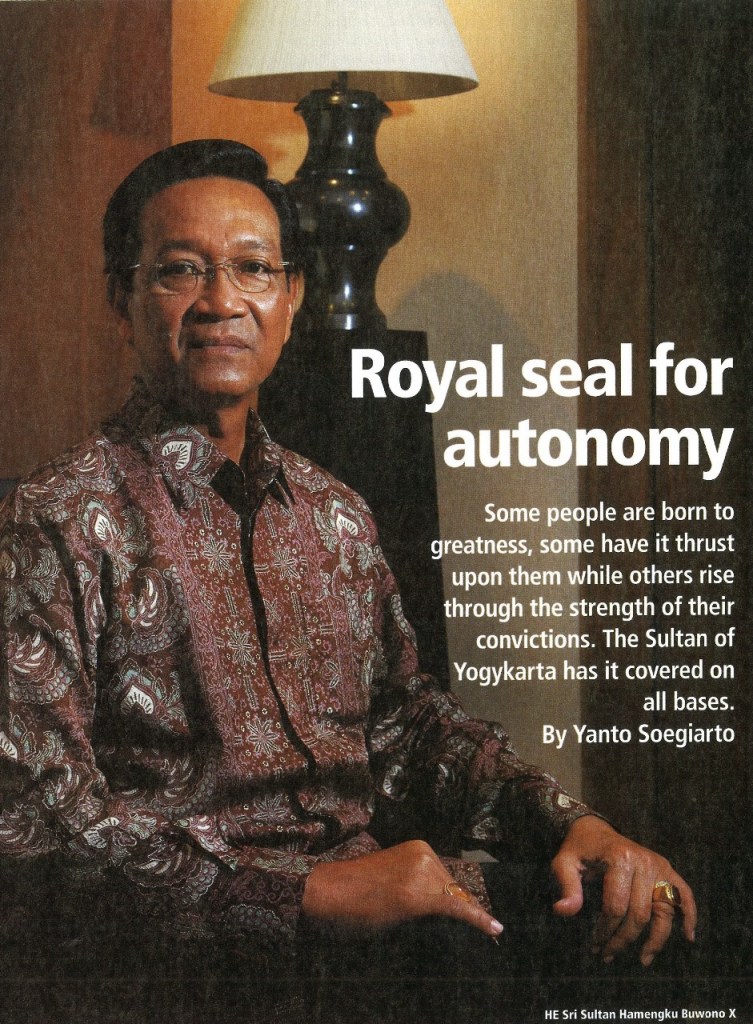
Royal Seal for Autonomy
By: Yanto Soegiarto*
AS first in line to the royal court of Yogyakarta, His Excellency Sri Sultan Hamengku Buwono X was born to a life of privilege. It is, however, a matter of pride to the sultan that he rose to his position as Governor of Yogyakarta through hard work and a driving desire to improve the life of the average Indonesian.
Political pollsters also rate him the third most popular man in the nation.
Now he is tipped for nomination for the coming presidential elections. As befits a person of royal blood, the sultan was not interested in discussing such crass pursuits as political power during an interview with GlobeAsia.
His thoughts are focused on autonomy. Regional autonomy should empower the national economy and pave the way for social welfare, he believes. Taking aim at the current administration, he says it is about time the central government realized that economic development in the provinces and regencies will eventually help boost national development as a whole. “If that rationale is not accepted, there’s no need (for the government) to talk about regional autonomy,” he insists.
The sultan claims 82% of money circulating in Indonesia is still locked in Jakarta. Yogyakarta received only Rp2.7 trillion in credits for development while total regional savings exceeded Rp12 trillion. “Only Rp 2.7 trillion circulated in Yogyakarta while the rest has been siphoned off to Jakarta. In such conditions how can the regions develop?”
The sultan has proposed the central government draw up a strategy to accelerate economic growth in the regions and formulate a mechanism to keep development funds in the regions. He also called for amendments to existing laws which, he says, are still very centralistic in nature. “Until now regional autonomy has been a pet project of the Home Ministry. Regional autonomy is forced to deal with other departments to make it work and the inter-departmental wrangling just never stops,” he says.
According to the sultan, the regions have accepted changes that encourage greater autonomy and prospered over the last four to five years. However, the central government has not changed its policy of accumulating regional funds for national budget (APBN) purposes. The funds are collected through the provincial and regency administrations. Under regional autonomy the role of the governor and regional administration should be to serve the region, not to act as an arm of the central government to collect national budget funds, the Sultan believes.
“Imagine, the governor installs the officials but has no right to know how much money the region has. Also, the governor has never been asked to give an accountability report. All they (the Jakarta administration) ask me is how much is spent for the regions. “If Iask what the regional funds are used for – they won’t tell me. There’s no difference to the New Order (the Suharto regime). It’s still very centralistic.”
Entrepreneurial role the sultan says the central government needs to reform the bureaucracy by adding entrepreneurship in the training of officials. “The kind of entrepreneurship we see now reflects on how to collect as much funds as possible from people in the form of retribution and levies to meet the demands of the central government. This is a burden for the people. Such practices are like colonial times under the East Indies.” Instead, officials should cut red tape and mobilize workers to become entrepreneurs in order to develop the regions.
“As Governor, the sultan is asked to manage the regions but in practice decisions are still made in Jakarta.” Speaking on the current state of the nation the sultan says that in its search for material wealth Indonesia has lost sight of its culture and values. Morals and ethics should reign supreme as the “commander” of development, he believes.
“History proved that development concepts based on material wealth have hurt the nation’s morale. Corruption, mark-ups and demoralization drove this nation into a crisis in the 1990s. People suffered,” he says.
The sultan says Indonesia needs to be united. “There’s still a lot of suspicion. We’re still differentiating on race, ethnicity and origin, ruler or common people, Javanese or Bugis or ethnic-Chinese, religion and so forth. Unless we’re united in perception this nation will not be able to cope with its backwardness and face globalization.”
The sultan’s outspoken views have prompted comments from leading political commentators. Sukardi Rinakit of Soegeng Sarjadi Syndicate, Syarif Hidayatullah Islamic University rector Komaruddin Hidayat and Prof. Dr. Mudradjad of the prestigious Gajah Mada University agree that morals and ethics should be placed on a pedestal if the nation is to take off. Indonesia lags behind Malaysia, Thailand and Singapore in per capita income at only $1,946 compared to Malaysia’s $6,146, Thailand’s $3,400 and Singapore’s $30,084.
Success as an economic power requires the achievement of three key conditions, the sultan says. First, the vision of the nation must recognize pluralism by no longer differentiating between race, ethnicity, origin and religion. Second, the fundamentals of economic development must be changed by upholding spiritual, character-building, morals and ethics instead of allowing pure economics to promote welfare, which will in the end lead to crooked business practices. Finally, says the sultan, a strategy emphasizing cultural values must be quickly put in place.
“The cultural approach in economic development enabled Japan, South Korea and China to prosper” he says. “We can also rise from backwardness if we implement the same strategy, putting morals and ethics on top.”
Yogya’s Queen the sultan’s wife, Kanjeng Raty Hemas – the Queen of Yogyakarta – is also politically active as a member of the Regional Representatives Assembly (DPD), focusing on the splintering of Indonesia into smaller and smaller administrative areas.
Previously, she held a position on the DPD panel on regional budgets. She says any new regions should not be too dependent on the state budget for subsidies and called on regional officials to be more self reliant as the state has limited finances.
She admits that the creation of new administrative areas poses many problems.
“The areas are so vast outside Java and communications are difficult,” she says. “The regional administration office of Ambon is based in Papua.
It is extraordinarily difficult when it comes to auditing regional funds” she told GlobeAsia at her home in Jakarta.
Ratu Hemas believes the members of the DPD need more authority, adding that even in areas they represent members are not consulted on the passage of laws or the drafting of regional budgets.
Asked if there were any difficulties communicating with the male-dominated House of Representatives, Ratu Hemas struck a blow for feminism: “The women’s forum at the House is far better in making ad hoc decisions than the male members”
On her role in Yogyakarta politics, Ratu Hemas says it is her duty as a member of the DPD to convey the aspirations of the people of Yogyakarta. “But it is very often difficult to pass their aspirations on to the DPR. The problem for us is that we can’t answer the people’s questions when we return to Yogyakarta.”
She believes Yogyakarta has a lot of potential in tourism and handicrafts. “These are not big economic issues,” she says. “Yogyakarta needs to revive the tourism and handicraft industry. Central government policy dealing with small and medium enterprises means the people of Yogyakarta are only workers for big exporters. We need to provide them with capital and entrepreneurial skills,” she says.
Asked to comment on a recent statement claiming the Sultan will refuse to run for another term as governor, Ratu Hemas declined to comment.
“What I can say is he doesn’t want to violate any regulations before his term ends. The people of Yogyakarta and Kanjeng Ratu Hemas will realize the sultan still protects and serves them”
Finally, asked who will emerge as the Sultan’s heir – the royal couple have no son to take the title – Ratu Hemas says the people of Yogyakarta will play a major role in any decision. “Under palace tradition the sultan may appoint a close kin to be successor” she says. “But that’s for later to decide – much later.”
*This interview was conducted in April, 2008.
+++
* About the Writer

Yanto Soegiarto
Alumnus of “Merdeka” Jalan Sangaji no. 11 Jakarta, the battle training ground for journalists. Educated abroad and trained in the US. Editorial writer on various local and international issues. Has covered many countries, including Vietnam, the former Soviet Republics, the Middle East and North Korea. Staunch advocate of freedom of expression and press freedom. Former Editor-in-chief of the Indonesian Observer newspaper, Head of Content of astaga.com, News Director of RCTI, Research Fellow at Soegeng Sarjadi Syndicate. Managing Editor at GlobeAsia Magazine, BeritaSatu Media and BBS TV Surabaya.
 Catatan Forum Senja