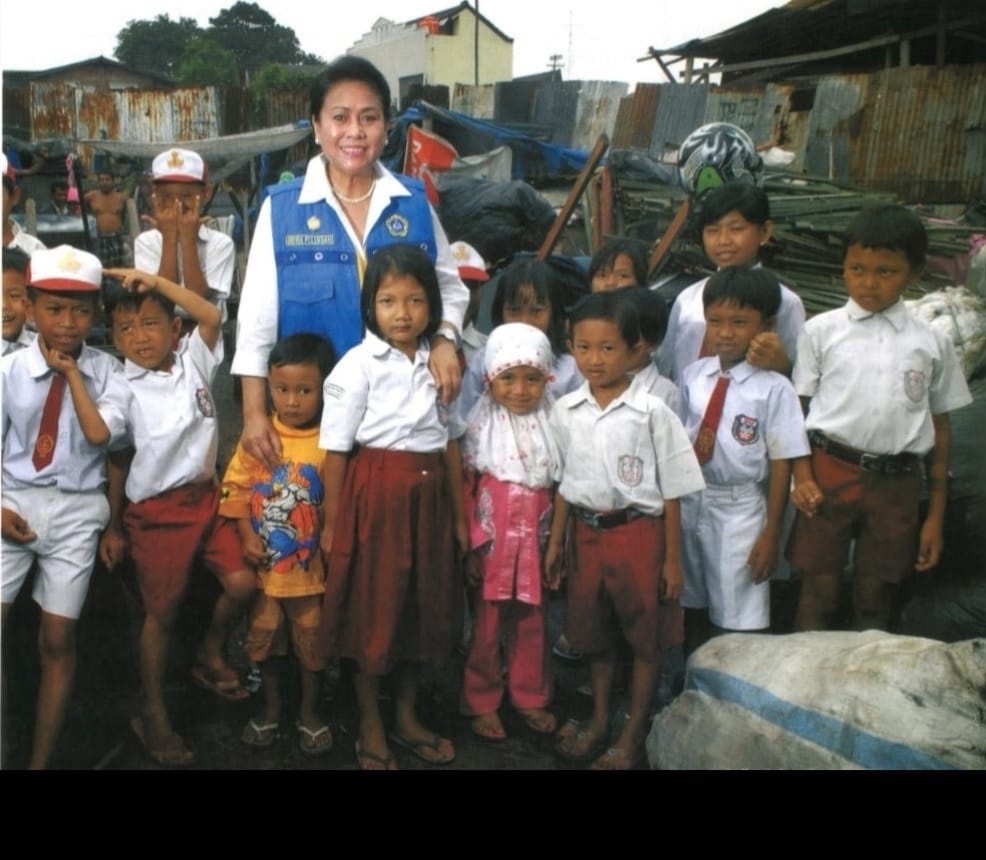
Education for the underprivileged
By: Yanto Soegiarto*
While GNOTA opened its books to underprivileged children of Indonesia in the nineties, educational philanthropic organizations are just finding their feet in Indonesia. Indira Pulungan faced immense challenges while building GNOTA and shares what lies between the lines of her success.
Indira S. Pulungan prefers not to look back at the start of the Foster Parent Scheme for Education (Gerakan National Orang Tua Asuh Foundation – GNOTA), when it was seen as a public relations vehicle for the Soeharto family. What’s important to her is that since 1996, GNOTA has in a quiet but consistent manner channeled a total of Rp141.872 billion to help unprivileged children, receive a basic education in all 33 provinces.
According to data dated June 30, 2007, GNOTА has channeled Rp11 billion in aid packages for the 2006-2007 school year. Its operations peaked in 1998-1999, with spending of nearly Rp37 billion.
However soon after the amount it was able to disburse then fell by around 50%, falling further in 2001.
Indira took over from founder Halimah Bambang Trihatmodjo in 2005 as executive director and insists that GNOTA is now an independent organization free of political intervention or business interest and will continue to serve the philanthropic cause to promote education in the country.
She admits that GNOTA began under a cloud of suspicion over its funding, since it was started during the New Order period as a social organization somehow related to the then-first family.
“This is why we take a low-profile stance. Many people do not understand the real story and that in fact we are helping thousands of poor and drop-out primary and secondary school children. It has been and will continue to be effective,” she insists.
According to Indira, a co-founder of GNOTA, many people misinterpreted the organization as a government-sponsored program. “No, GNOTA is purely a non-profit foundation which was set up by individuals who care and have sympathy for underprivileged children. “We work to help children go to school, buy books and school uniforms. We work together with the government as an independent organization.”
“In 1996, there were thirteen of us from various backgrounds who gathered and set up GNOTA. All of us were committed to run this foster-parent scheme for education and we are still consistent in our ideals,” she says.
The yoga enthusiast explains that GNOTA gets its funding from individuals, business leaders, foreign institutions, foundations, companies and Indonesians abroad.
“The largest portion comes from the foundations. I know certain individuals who have been donating part of their wealth for this cause since the very beginning. Indonesian students studying at (Singapore’s) Nanyang University have made contributions,” she said.
Large companies contribute funds to education by becoming foster parents. In one such case, milk producer Sari Husada sponsors 2000 children, with its donation distributed to the children through GNOTA.
Indira’s main task as executive director Is to make sure the program is running effectively and efficiently, and that its programs are completed on time.
She also has to work hard to maintain communication with the foundation’s supporters and financial backers.
“The hardest part is getting accurate data on the number of underprivileged children in remote areas and isolated villages,” she says.
“At one time, we went by helicopter to Waropko In Papua, and imagine, there was a school with 60 students from grades 1 to 6 occupying just one classroom and with one teacher who was only a primary school graduate,”
Indira recalls.
GNOTA works closely with the Department of Social Welfare, the Department of Education, Bank Rakyat Indonesia and the Post Office.
“We will continue to work with BRI and Pos Indonesia as our main partners in channeling the aid packages,” says Indira.
Missed target
The government’s current target is to see all Indonesian children complete basic education by 2015, as part of the UN-sponsored Millennium Development Goals (MDGs).
Meanwhile, the government’s own target for achievement of nine years of compulsory education is 2008, but it’s unlikely the deadline will be met. West Java, for example, is one province that will not be able to achieve the nine-year goal.
The provincial government is now working closely with GNOTA, which operates both at the national level and in the provinces, regencies, districts and villages.
Difficult economic conditions have created a jump in the number of poor children. Based on a 2006 survey, the number of children who cannot afford basic education was 26.1 million.
The government has only allocated a budget amounting to 12% of the total state budget to education, even though the 1945 Constitution requires the state to allocate 20% of the budget to educating the nation. This has prompted a fight among the various factions of the House of Representatives (DPR).
“We have tolerated the government’s allocation of 12% of the budget for 2006-2007, but the government is violating the law,” says Djoko Susilo of the Caucus for Education.
Despite the political wrangling at the DPR and elsewhere, GNOTA continues to keep its eye on its task of aiding education for the poor. Indira and her assistants, A. Piet Simandjuntak and Aurina Setyawitta, stand firm on the principle that GNOTA’s activities should not become a political football. They are backed by the hierarchy of GNOTA, in which Halimah Bambang Trihatmodjo is chairman of the supervisory board, supported by board members Anti Soeroso, G. Siti Hatmanti, Jeanette Sujunadi, John Prasetio, MS Rallie Siregar and Sarsito N. Sarwono. The foundation’s activities are overseen by a supervisory board, composed of Noke Kiroyan, Junanda P. Syarfuan, Lelyana Santoso and Dr. Arif Rahman.
Indira notes that in April this year, Vice President Jusuf Kalla called for the promotion of CSR in Indonesia, while Social Affairs Minister Bachtiar Chamsyah said regulations on CSR will be ready this year. These regulations will govern corporate social responsibility, including the requirement for companies to devote a part of their net profits for social purposes.
“This is very good but I don’t see why this needs to be regulated,” says Indira. “And there’s talk about sanctions. I think philanthropy, CSR and the like, it’s all about conscience and it is the way it is implemented that’s important.
“We started a long time ago. Now all of a sudden people are talking about philanthropy and corporate social responsibility,” she says wearily.
Established position
Despite its desire to be low-profile, GNOTA has developed a reputation for delivering the goods. Indira recalls that during the Expo CSR earlier this year there were a lot of questions about GNOTА.
“There were suggestions and criticisms but many people asked why there was so little publicity and others wanted to work together with us and wanted GNOTA to develop a stronger role in assisting education.”
GNOTA’s largest group of aid recipients is in East Kalimantan, with 11,168 underprivileged children. Even in oil-rich Bodjonegoro, about 48,000 families are underprivileged. GNOTA, along with the local government, assists 175 primary school children.
Head of the GNOTA office in the regency, Widji Astuti Santoso, says the foster parent scheme, when integrated with government programs, has proved to be an effective means of reducing illiteracy.
“The level of illiteracy is still quite high but government funding is limited. We are optimistic that at least we are here to help reduce the number of those who can’t read and write,” she says.
In West Java, for the 2005-2006 and 2006-2007 school years, GNOTA has allocated around Rp500 million to assist 2000 children all over the province. Great care has been taken in the selection of candidates to avoid duplication of aid.
The much-questioned beginnings of the scheme continue to resonate.
Prof. Dr. Soenjono Dardjowidjojo of the Indonesian Teachers’ Institute comments that the idea of GNOTA working together with the government in helping underprivileged children go to school “is a bright idea but should be accompanied with transparency on the origin of the funds.”
Prominent psychologist and education analyst Drs. Arief Rahman, who sits on the board of supervisors, rejects the criticism. He says GNOTA helps other social organizations in providing accurate data to avoid over-lapping of aid distribution.
“GNOTA has complete information, evaluation and important notes which are useful in formulating and calculating how much aid is needed,” he says.
On the questions over transparency and accuracy, Indira says all data are updated and well-maintained.
“We are a transparent organization,” she insists.
This article was published in December 2007.
+++
*About writer:

Yanto Soegiarto
Alumnus of “Merdeka” Jalan Sangaji no. 11 Jakarta, the battle training ground for journalists. Educated abroad and trained in the US. Editorial writer on various local and international issues. Has covered many countries, including Vietnam, the former Soviet Republics, the Middle East and North Korea. Staunch advocate of freedom of expression and press freedom. Former Editor-in-chief of the Indonesian Observer newspaper, Head of Content of astaga.com, News Director of RCTI, Research Fellow at Soegeng Sarjadi Syndicate. Managing Editor at GlobeAsia Magazine, BeritaSatu Media and BBS TV Surabaya.
 Catatan Forum Senja